Gasping for air
Confessions of an Opera Singer on Breathing

Hate reading? Listen to it here:
Welcome to the Sunday Confessional where I’ll not so candidly confess my sins as an opera singer.
Today? My breathing sins laid bare.
We all know that deep-down, that Daddy Lamperti is right.
A silent breath is the ideal breath,
but here’s my confession:
I have been a notorious gasper-of-air. I have indeed forced large loud gasps of air down my throat as I fight for my life on stage.
but here’s a deep dive on why I keep trying to get better:

I recently traveled to Heidelberg to work with my teacher. Roberta was there giving a day of masterclasses. When she plans one of these, it’s my favorite thing because I get to observe everyone else’s lessons. I always end up learning a ton—not just about myself, but also about how to serve my own students better.
And like every masterclass, a lot of good little vocal technique and philosophy reminders came out of it.
Here are some thoughts about breathing that I scribbled down in my practice journal to take back with me into the practice room:
Big thought:
An inaudible breath is the optimal breath to strive for. Loud breathing is a symptom of a closed throat.
A few thoughts and experiments on this to nuance all of our thinking. First, let’s start with the Bernoulli principle. If you’ve done your due diligence in your voice ped class, you’ll probably associate the Bernoulli effect with the drop in localized pressure that causes the vocal folds to elastically close and reopen.
Here’s what is basically happening when we phonate: 1) we move air 2) the laryngeal muscles draw the vocal folds together 3) subglottal air pressure causes them to open, while the increased velocity of air going through them creates a drop in air pressure. This creates a suction effect (Bernoulli) that closes them again. As long as we keep moving air and imagining pitch, the cycle continues.
COOL. BUT. Here we are talking about expiration. Have you ever thought about the Bernoulli effect and inhalation?!?!?!?!?!
Try this: Close your mouth and breathe in super quickly through your nose. What happens? It gets more and more difficult. Your nostrils constrict. And the inhale gets louder. See where I’m going with this?
The increase in air velocity is causing a drop in pressure that makes the nasal passages constrict. Now map this onto your throat and your inhalation during singing. When you start hearing those audible inhales, that is Bernoulli working against us. If the throat starts constricted, then we’re going to have to work pretty damn hard (and audibly) to get the air both in and out.
Now, despite my trying, I’m still a chronic air-sucker. Let’s be honest: sometimes the stage is a war zone. And sometimes we are singing in situations where we are fighting for our lives. So before the internet gets huffy about me publishing a widely held opinion on vocal technique… let me just say: I have and will continue to fail at this until I sing my last dying note.
So what’s the fix?
Well, first let’s start with a little awareness, forgiveness, and refusing to do things things 100% perfectly.
In fact, the biggest life hack I’ve ever discovered is half-assing things. IDK why, but it’s helped me be consistent - and the result is often way better. I think it’s because it’s not about me judging myself; it’s about doing whatever fun thing I’m trying to learn.
Secondly… here’s a half-assed list to half-ass ponder:
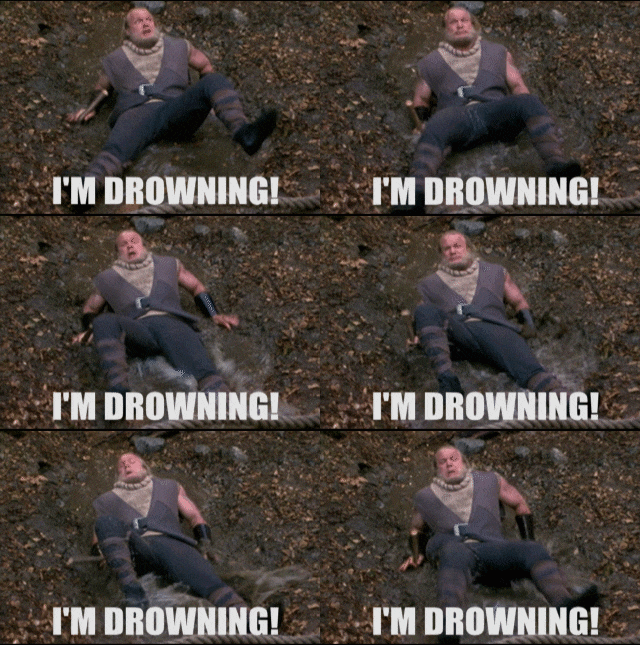
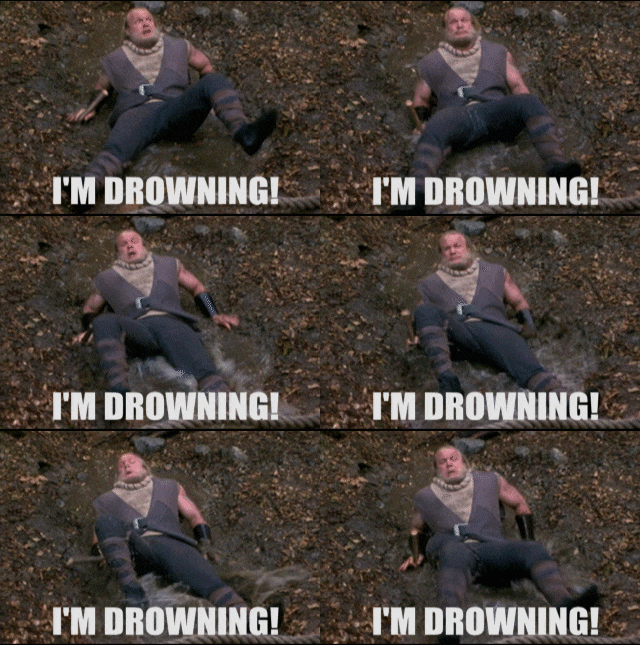
I’ve found out that I don’t need as much air as I think I do. And if I need more, I can just get a little top-up literally whenever I want. However, doing this causes my lizard brain to set off alarm bells—which is my theory as to why Lamperti and my teacher Roberta say that for a while at the beginning… it will feel like you’re drowning, until you can begin to trust.
Sometimes I think my throat is open, but actually its just my mouth that is wide open. Shocker: sometimes you do indeed have to open your mouth to sing. BUT an open mouth does not necessarily equal an open throat. So I use a “check yourself before you wreck yourself” strategy here.
In my last lesson, Roberta made this point:
It’s best to concern yourself less with “getting a good breath” and more with how the breath is abundantly moved.
Lamperti talks about “all breathing being reactions to words and melody and emotional content.” One way I’m currently interpreting this is that the more air I use, the more air comes back to me. Literally.
You have to give up your air to receive more air. And the more abundantly you give up that air, the more you’ll naturally get back. The more open you stay to giving and receiving all of this- the more pleasurable, silent, and easy breathing will be.
There’s definitely a metaphor for life somewhere in there.
I hope this brings you something in the practice room or on stage this week
xoxo,
Martha
Singer Resources
30 Day Vocal Exercise Challenge — I’m honestly so thrilled with the feedback from singers going through this program. Access to 30 Days of Vocal exercise and how to track your progress with the Practice Journal Method.
The Free Principles of Practice Email Course — Dip your toe into the principles behind the Practice Journal Method and the 30 Day Vocal Exercise Challenge.